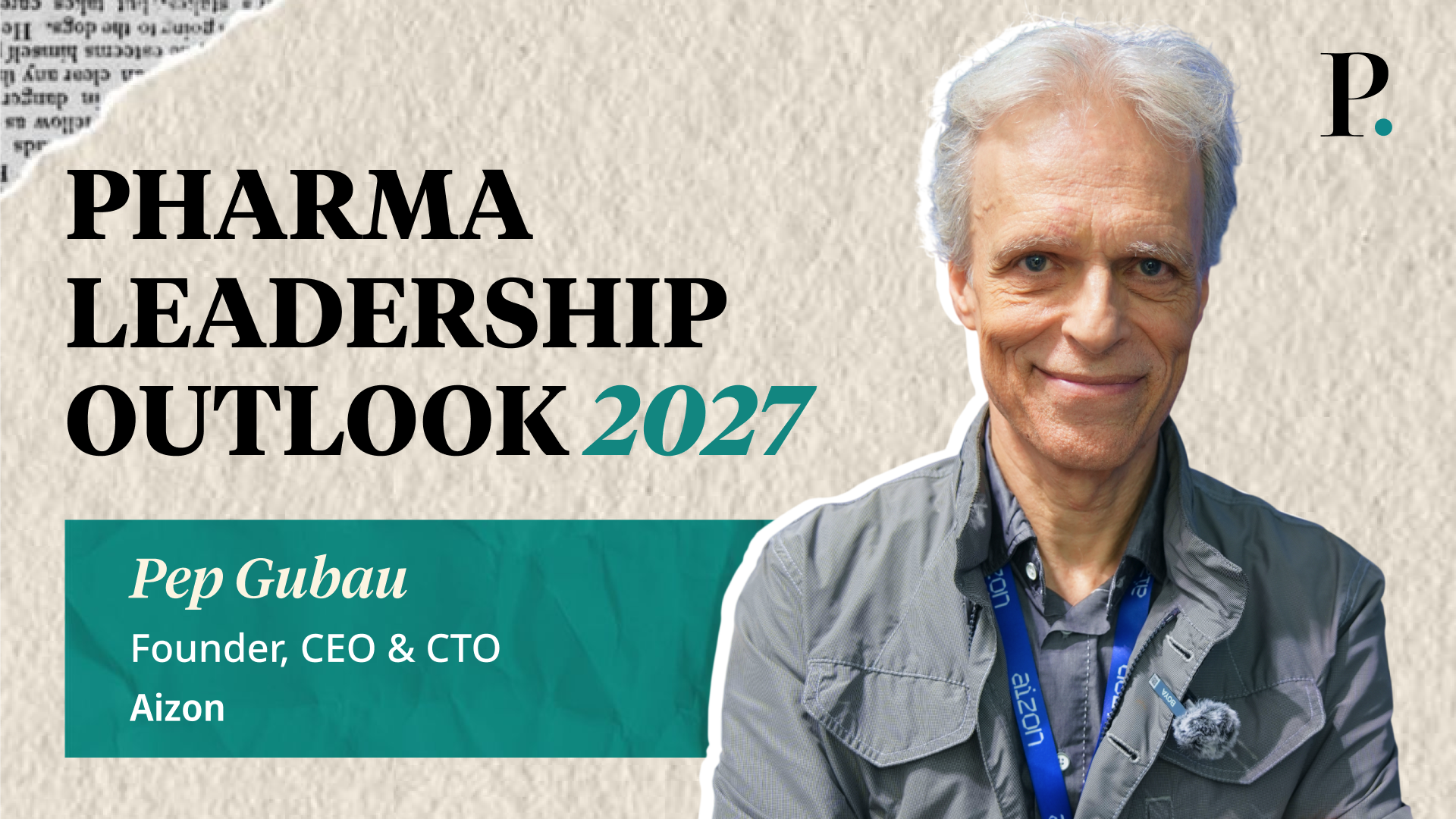
At CPHI Milan 2026, Aizon's Founder and CEO Pep Gubau sat down with Michael Bani, Editor-in-Chief of Pharma Now, to talk about how AI is changing pharma manufacturing. After 40 years in the industry and more than 12 years leading Aizon, Pep offered a candid view of what's working, what isn't, and why the pace of change has never been faster.
Here are the key takeaways.
From a "tough sell" to a business necessity
Aizon was founded on a strong conviction: that manufacturing sites will eventually become self-driving, with algorithms informed by data making the best decisions in order to manufacture.
In 2014 and 2015, that was a hard message to sell. "We were pitching AI in 2014, ‘15. It was not sexy. ChatGPT did not exist," Pep recalled. Aizon invested heavily in the community, publishing white papers, taking part in ISPE and PDA, and engaging with the FDA and EMA to help move the industry forward.
What changed was the shape of manufacturing itself. "When I started 40 years ago”, Pep recalls, it was about dedicated lines, single products, dedicated sites “churning out blockbusters all day long." Today, outsourcing to CMOs and CDMOs is everywhere, and those companies "don't have the privilege of owning a molecule." For them, everything comes down to margins, and technology is one of the key ways in which they can differentiate themselves and create digital capacity.
Why so many AI pilots fail
Pep sees a lot of opportunistic, AI-driven projects in the industry, and he isn't surprised that many of them fail. "Money goes where opportunity is," he said. But pharma manufacturing isn't "a pizza app or a dating app”, it’s actual drug manufacturing for humans.
In his view, pilots fail when they're applied in the wrong place, with no real impact or return. "If you do a pilot that generates an ROI of $30 million, I'll tell you, that's going to be successful," he said. Too often, AI becomes "just a check box," something a team does because the board asked for it, rather than a way to solve a real pain with a measurable outcome.
That's why industry knowledge matters so much. "We are not tech people doing pharma. We are pharma people doing tech," Pep said. Companies that get the right advice, from partners who understand the process, its challenges and compliance, are the ones that succeed.
Where AI delivers results today
In a GMP process, Pep explained, AI is "nothing else than fancy mathematics." What every manufacturer wants to know is why something happened, and that's root cause analysis. "If that thing is good, I want it to happen often. If it's bad, I want to avoid it."
That translates into three areas of impact:
- Deviation avoidance: seeing ahead of time that a batch may go out of specification, so it can be prevented.
- Yield optimization: finding the ideal settings within approved ranges, instead of repeating the same settings every time.
- Digital capacity: producing more from existing plants as a result.
The right AI in the right place
Asked about agentic AI, Pep was clear that agents are useful, as long as they're applied in the right place. Because the industry makes medicines for patients, the technology has to be "traceable, auditable, explainable and repeatable." A probabilistic large language model can't be used to determine the ideal setting for releasing a product to patients. Deterministic machine learning models can.
But agents have a powerful role in how people use that intelligence. Instead of building dashboards and applications with drag-and-drop tools, Aizon customers can now simply ask, in their own language, for something like "a dashboard that shows me the current batches sorted by deviations." The agent builds the interface, while the data it shows comes from a GMP data foundation and validated machine learning models.
Pep also pointed to a shift in how regulators frame the human role: from a "human in the loop" checking outputs, to human oversight across the whole process.
Regulators are no longer an excuse
"It's the first time in 40 years of career I see regulators ahead of the industry," Pep said. Both the FDA and the EMA have published draft guidance on AI with clear definitions, and they are actively pushing for digitalization.
The reason is simple: regulators serve patients. With pandemics, geopolitical pressure to onshore manufacturing and the limits of how fast new plants can be built, anything that helps produce better medicines faster and more affordably is in their interest. "We need to do everything possible to make sure we are producing the necessary drugs for the population," Pep said. "Or the other option is drugs are going to be only for rich people."
The industry is moving at different speeds, but one thing has changed for everyone: "The excuse of 'there is no regulation' is not valid anymore."
No data, no AI
For many companies, the real obstacle is data readiness. "No data, no AI," Pep said. When Aizon launched its first products, Unify and Predict, some customers asked whether predictive analytics could work on paper batch records.
He shared a conversation from CPHI Milan itself: a company considering buying GPUs to build AI models, while still running its batches on paper. "Maybe there are different steps to take," he said.
Pharma, Pep noted, "has the most data on the planet," but it has mostly been used for reporting rather than decisions. With data spread across disconnected silos, the challenge is unifying it in a way that is validated and GMP-ready. "Data readiness is the first thing you need to tackle. Make sure you have GMP data you can use, and then leverage AI."
Winners and losers are being decided today
Asked where the industry will be in five years, Pep laughed: "I'm not sure I see where it's going next year." Change that once took years now takes weeks. "Every week I go back home and tell my wife, 'We are in a different era.' And she tells me, 'You told me that last week.'"
His prediction is clear, though. "Winners are going to be the ones embracing the technology as fast as possible," he said, while those that keep working as they always have will struggle to compete. "Winners and losers are being decided today."
And his wish for the industry’s next five years? "That we supply every single drug that is necessary, and that everyone can afford the drugs they need."
Watch the full interview here: